
Consultations and follow-ups are free
Much of what is written about Emsella does not say what the NHS offers first or who the chair cannot help. This guide is written by the team that runs Emsella at our clinic in the Harley Street medical district and reviewed by our clinician. It gives you the numbers from the actual studies, the regulator's own list of side effects, how we price it, and the honest answer to whether it is right for you.
What Emsella is
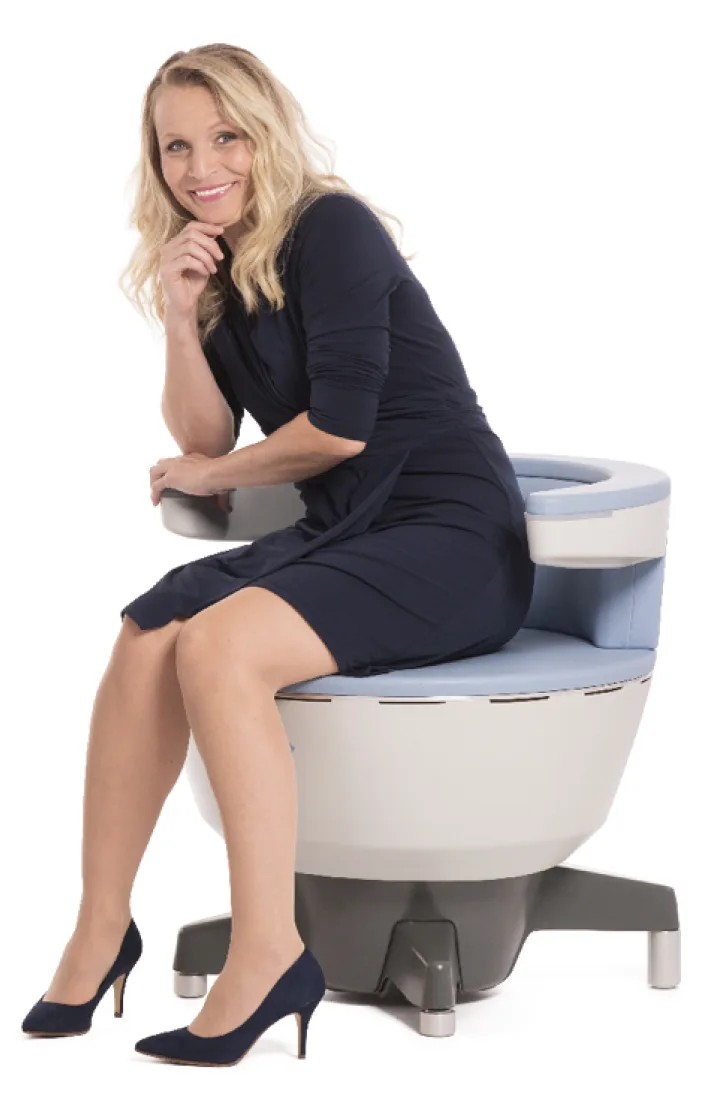
Emsella is a treatment chair made by BTL Industries. A coil in the seat produces a pulsed magnetic field, which BTL calls HIFEM, high-intensity focused electromagnetic energy. The field passes through clothing and tissue and makes the nerves and muscles of the pelvic floor contract. BTL says the field makes the pelvic floor contract more often and more strongly than you can voluntarily; no published study we found measures that. The US regulator's 2018 summary for BTL's pelvic floor chair describes the field as 0.7 to 2.5 tesla at 1 to 150 pulses a second, for up to 30 minutes.
BTL says one session delivers over 11,000 contractions; that is the company's figure and we found no published study that counts them. The aim is the same as the aim of pelvic floor exercises: a stronger, more responsive pelvic floor that closes the urethra when you cough, sneeze, laugh or run, and that helps the bladder hold on when it wants to go.
You stay dressed. You sit on the chair with your feet on the floor, the clinician sets the intensity, and for 28 minutes you feel strong tingling and the muscles pulling and releasing. There is no probe, no electrode on the skin and no undressing.
Does Emsella really work?
For stress and mixed incontinence in women, most women in the published studies reported improvement, and it is worth being clear about how strong that evidence is.
- The main study (Samuels, 2019) treated 75 women, average age 55, with six 28-minute sessions over three weeks. Their score on the standard incontinence questionnaire (ICIQ-SF) fell from 10.6 to 4.2 at three months, a 64% improvement. 81% reported a significant reduction in symptoms after the sixth session. Among the 43 who used pads at the start, pad use fell by 54%; 35% of them needed no pads after the sixth session and 44% at three months. There was no comparison group, so some of the change may be the natural ups and downs of symptoms and the effect of attention.
- A second single-arm study (Tosun, 2024) treated 35 women: the same score fell by 60% at one month, and 31% scored zero.
- A retrospective, non-randomised comparison in women aged 18 to 45, at least six months after a vaginal birth (Silantyeva, 2020), found a 52% improvement in pelvic floor symptoms with ten sessions on the chair. The comparison group, on a home electrical stimulator that is not FDA-cleared, improved by 18%, measured straight after treatment.
- Urge incontinence responded less early: in the main study the urge-only group improved by 27% after the sixth session and 54% at three months, against 67% for stress incontinence.
- The longest follow-up we found is nine months, in a conference report on 33 women whose scores were still 60% lower. We found no study that follows people for a year, and no completed trial that compared the chair with a sham chair; several are registered, and some are still recruiting.
So the realistic picture is a meaningful reduction in leaks for most women with stress or mixed incontinence, measured over months, from studies that are small, mostly uncontrolled, short, and in several cases run by clinicians who use the device. The "95% improved quality of life" figure that appears in BTL's materials comes from a BTL survey of about 30 women who were asked how they felt; it is a satisfaction figure, not a measure of how many women were dry.
What the evidence supports:
- Stress incontinence: leaking with a cough, a sneeze, a laugh, a run or a lift.
- Mixed incontinence, where urgency and stress leaks both happen.
- Leaks from weak pelvic floor muscles after childbirth, once the body has recovered.
What Emsella does not do:
- It does not treat pelvic organ prolapse. There is no evidence it treats prolapse, it is not a cleared indication, and one health-technology review excludes stage three or higher. We assess for it before we book you.
- It does not fix an overactive bladder on its own, and it is not for overflow incontinence or a neurological bladder problem.
- It has no published evidence for erectile dysfunction; one trial is recruiting. We will not sell it to you for that.
Who Emsella suits, and who it does not
BTL's pelvic floor chair is cleared in the US for urinary incontinence in women and men. Most of the evidence is in women with an average age of about 50 to 55 with stress or mixed incontinence, and the chair is used for men after prostate surgery, where the evidence so far is one study of 27 men followed for a month.
The full contraindication list is in BTL's user manual for clinics. The list below is the exclusions used in the clinical trials and in common practice, and we check it against the manual at your consultation:
- A pacemaker, a defibrillator or any implanted electronic device.
- Metal implants in the pelvic area, including a hip replacement, or a copper coil (IUD). Tell us about any coil and we check the manufacturer's guidance before we book you.
- Pregnancy, planning a pregnancy, and at least the first three months after giving birth (the exclusion used by a health-technology review).
- Recent pelvic or abdominal surgery that is still healing.
- An untreated cancer.
- Under 18.
Advice differs on treatment during a period, so tell us when you book and the clinician will advise. If you have a bleeding disorder, epilepsy or an active pelvic infection, bring your history and the clinician decides case by case.
We do not offer Botox or dermal fillers, and nothing about Emsella is injected or inserted. If you have had bladder Botox elsewhere, tell us when and how it worked; the clinician will decide whether to go ahead.
Not sure you are suitable? Ask the clinician, it is free
What a course is like, step by step
- Consultation. The clinician asks about your leaks, what sets them off, what you have already tried, and whether there is any sign of prolapse or a condition that needs a doctor first. In our practice you also answer the ICIQ-SF questionnaire the studies use, so there is a number to compare with later. Consultations and follow-up reviews are free.
- The first session. You sit on the chair in your clothes, feet flat, and the clinician raises the intensity in steps until the contractions are strong but comfortable. In our practice the first session is set lower than the rest while you get used to the feeling.
- The course. Six sessions, twice a week, over three weeks, 28 minutes each; that is the protocol used in the published studies and the one we follow. You can read or talk during the session; ask us about your phone.
- After each session. You walk out. In our experience some people feel muscle fatigue or mild soreness in the pelvic floor for a day, as after exercise. The main study reported no downtime.
- Review. Our protocol is a review at the end of the course and again at six months, with the same questionnaire each time.
How many sessions, when you see the result, how long it lasts
| Feature | What to expect |
|---|---|
| Sessions in a course | 6, twice a week over 3 weeks (the published protocol) |
| First change | In our experience some people notice fewer leaks after one or two sessions; the studies measured at the sixth |
| Main result | The main study's scores were lower after the sixth session and lower again at 3 months |
| How long it lasts | Measured to 3 months in the main study and 9 months in a conference report; we found no 12-month study. In our experience the benefit holds for most of a year and fades gradually, like any muscle training |
| Maintenance | No published schedule. In our experience a single top-up session every 6 months or so tends to maintain the result; we review you at 6 months and decide together |
| Alongside | Pelvic floor exercises keep working after the course; the chair is not a reason to stop them |
Is one session enough to tell? No. A single session shows you what it feels like, not what it does; the studies and our protocol use six.
What Emsella costs in London
Emsella is priced per session, and a course is six sessions over three weeks. We price Emsella from a starting price per session and per course, confirmed in writing at your free consultation, and we price match any comparable written quote. Finance through Humm is available, subject to status, with terms that depend on the amount. Consultations and follow-up reviews are free whatever you decide.
Consultations and follow-ups are free
Results you can check
There are no before and after photographs for incontinence, so be wary of any page that shows them. What you can check is a questionnaire score: in our practice we ask you the ICIQ-SF questions the studies use at the consultation, at the end of the course and at six months, so you can see your own numbers.
Patients have reviewed the clinic on review.clinic, the review service we use, where Emsella at our clinic holds 4.9 out of 5 from 104 reviews, with 98% saying the treatment was worth it (). Read the ones that say what the leaks were like before; they are the most useful.
Is Emsella available on the NHS?
Not as part of the standard pathway. We found no NHS service that offers it, and NICE, which decides what the NHS should use, has not assessed the Emsella chair. What the NHS offers first, and what NICE recommends as first-line treatment for stress or mixed incontinence in women, is supervised pelvic floor muscle training for at least three months. That means at least eight contractions, three times a day, with a physiotherapist or continence nurse checking you are doing them right. On the closest category of device, electrical stimulation, NICE says the evidence of benefit is limited, advises against routine use alongside pelvic floor training or for overactive bladder, and suggests considering it for women who cannot contract the muscles on their own.
Our honest position is that the chair sits alongside that advice, not above it. If you have never had supervised pelvic floor training, ask your GP for a referral to the local continence service; it is free, and many women improve on it. The chair is a private option for people who want to add stimulated contractions to exercises, who have tried exercises without enough change, or who cannot feel the muscles well enough to train them. You do not need a GP referral to book with us.
Does the Emsella chair fix prolapse?
No. A prolapse is the bladder, bowel or womb pressing into the vagina because its support has stretched. There is no evidence that the chair treats prolapse, it is not a cleared indication, and one health-technology review excludes stage three or higher. NICE suggests considering supervised pelvic floor training for at least 16 weeks for a stage 1 or 2 prolapse with symptoms, and a vaginal pessary for symptomatic prolapse, with surgery for more severe or non-responding cases. If your leaks come with a dragging feeling, a bulge or difficulty emptying, see a doctor or a women's health physiotherapist first; we will tell you the same at the consultation.
Emsella compared with the alternatives
| Feature | Emsella chair | Supervised pelvic floor training | Vaginal electrical stimulation | Surgery |
|---|---|---|---|---|
| What it does | Contracts the pelvic floor for you with a magnetic field | You contract the muscles yourself, with a physiotherapist checking | A probe delivers an electrical current to make the muscles contract | A sling or a suspension holds the urethra or neck of the bladder |
| Evidence | Small, mostly single-arm studies, 1 to 9 months; we found no sham-controlled trial | NICE first-line treatment | NICE: evidence of benefit limited; considered for women who cannot contract the muscles | NICE options after non-surgical treatment has failed; mesh tape was placed under a high-vigilance restriction in England in 2018 |
| Sessions | 6 over 3 weeks | At least 3 months, then ongoing | Typically a course of home sessions; ask your physiotherapist | One operation |
| Downtime | None reported in the main study | None | None | Recovery time varies |
| Cost | Private | Free on the NHS | Private or NHS | NHS or private |
| Who it suits | Stress or mixed leaks; people who cannot feel the muscles; people who want a clothed, hands-off option | Everyone, first | Women who cannot contract the muscles | Stress incontinence that has not responded to the above |
The evidence and session rows reflect the sources named; the "who it suits" row reflects our clinical experience.
Emsella vs Kegels. They train the same muscles. The chair does the contractions for you. It may suit people who cannot feel the muscles or struggle to keep up exercises, but that is our clinical judgement, not a trial result. It has not been shown to be better than supervised training in a head-to-head trial, and a 2022 Abu Dhabi health-technology review listed it as not as effective in the long run as pelvic physiotherapy and suitable as an adjunct to a physiotherapy programme. We say the same: do both.
Emsella vs EMfemme 360 and vaginal laser. These are different treatments for a different problem. EMfemme 360 heats the vaginal tissue with radiofrequency, and BTL's radiofrequency devices are marketed in the US for heating tissue, not for incontinence or laxity. In the US regulator stated that it had not cleared or approved any energy-based device used in the vagina, laser or radiofrequency, for vaginal rejuvenation, vaginal cosmetic procedures, or treating menopause symptoms, urinary incontinence or sexual function. That warning is about those devices, not about the magnetic chair. NICE says vaginal laser for incontinence should only be used in research. If a clinic offers you either for leaks, ask for the evidence.
Emsella vs surgery. Surgery lifts and holds; the chair strengthens. NICE offers colposuspension or a sling made from your own tissue after non-surgical treatment has failed, and also includes a mesh sling option with additional guidance. We found no trial of the chair against surgery. If you are being offered an operation, ask whether trying the chair alongside supervised training first is reasonable for you; it is not a reason to refuse surgery you need.
Consultations and follow-ups are free
Side effects, and who should think twice
The US regulator's summary lists the side effects that can accompany the treatment: muscular pain, temporary muscle spasm, temporary joint or tendon pain, a temporary increase in local circulation, increased sensitivity during intercourse, and redness of the skin. The main study reported no treatment-related adverse events, with minor muscle fatigue noted; a second reported mild, passing side effects without counts; and a 2025 review calls side effects uncommon and mild where they were recorded, with inconsistent reporting.
In our experience the common complaints are a feeling of having exercised and tingling that lasts an hour; some people describe a brief increase in urgency in the first week before it settles. Tell the clinician if the contractions are painful rather than strong; the intensity comes down.
The things to think twice about are the exclusions above, especially metal or electronics in the pelvis, and the two questions the chair cannot answer: is this a prolapse, and is this a bladder problem that needs a doctor. Blood in the urine, pain, a sudden change in symptoms or leaks that started with a new medicine need a GP before any chair.
How to choose an Emsella clinic in London
- Ask what they will measure. A clinic that runs the ICIQ-SF questionnaire before and after is a clinic that expects to show you a result. Ours does.
- Ask who assesses you and who supervises. Our sessions are run by trained clinicians in a doctor-led team, and this guide is reviewed by Dr Marie Duggan, GMC 7488383.
- Ask about prolapse and the NHS. A clinic that says the chair fixes prolapse, or that there is nothing on the NHS, is wrong on both.
- Ask for the course price, not the session price. A single taster session is one of the six you need.
- Check the device. A genuine BTL Emsella chair; ask the clinic to show you the device and its BTL branding.
- Check the regulator. The clinic should be CQC registered. Ours is, registered at our group's Harley Street address.
Aftercare
There is nothing to do after a session. Keep doing your pelvic floor exercises, because the muscle you build on the chair is the same muscle, and keep a note of your leaks through the course so the review means something. Drink normally; cutting fluids to avoid leaks makes urgency worse. If you are seeing a physiotherapist, tell them you are having the chair, and tell us what they have advised.
Consultations and follow-ups are free
Frequently asked questions
Does the Emsella chair really work?
In the published studies most women with stress or mixed incontinence reported improvement: a 64% fall in bladder symptom scores at three months and about half as much pad use in the main study of 75 women. The studies are small and uncontrolled, so treat the numbers as the best case, not a promise.
How much does the Emsella chair cost in London?
We price Emsella from a starting price per session and per course, confirmed in writing at a free consultation, and we price match any comparable written quote. Finance through Humm is available, subject to status. Consultations and follow-up reviews are free.
How long do Emsella chair results last?
The studies measured to three months, and one conference report to nine. In our experience the benefit holds for most of a year and fades gradually, and a top-up session every six months or so tends to maintain it. Pelvic floor exercises help it last.
Is Emsella available on the NHS?
Not as part of the standard pathway, and NICE has not assessed it. The NHS offers supervised pelvic floor training first, for at least three months, through your GP and the local continence service. The chair is a private treatment; you do not need a referral to book it.
Does the Emsella chair fix prolapse?
No. There is no evidence that it treats prolapse and it is not a cleared indication. NICE suggests considering supervised pelvic floor training for at least 16 weeks for stage 1 or 2 prolapse with symptoms, and a vaginal pessary for symptomatic prolapse, with surgery for more severe or non-responding cases. See a doctor or a women's health physiotherapist first.
What is Emsella, in one sentence?
A treatment chair that uses a magnetic field to make the pelvic floor muscles contract repeatedly in 28 minutes, while you sit on it fully clothed, to treat urinary incontinence.
How many sessions do I need?
Six, twice a week over three weeks, which is the protocol used in the published studies and the one we follow. A single session shows you what it feels like, not what it does.
Does Emsella hurt?
It is not pain-free. You feel strong tingling and the muscles pulling and releasing, the regulator's summary lists muscular pain and temporary spasm as possible side effects, and in our experience some people are sore the next day as after exercise. The clinician sets the intensity to a level you can hold and brings it down if you ask.
Is there any downtime?
None was reported in the main study. In our experience you walk out, drive, work and exercise as normal.
Does Emsella work for men?
It is cleared for men as well as women. The evidence in men is one study of 27 men with leaks after prostate surgery, followed for one month, in which symptom scores fell by about 60%. For erectile dysfunction there is no published evidence and we do not offer it for that.
Can I have Emsella with a coil?
A copper coil is a common exclusion, because the magnetic field can act on metal. A hormonal coil contains no metal, but we do not say it is fine until we have checked the manufacturer's guidance for your device at the consultation. Tell us which coil you have.
Can I have Emsella after a C-section, or after the menopause?
After a caesarean, once the scar has healed and the clinician has cleared you. The one comparison in women after childbirth enrolled women at least six months after a vaginal birth, and a health-technology review excludes the first three months, so we do not treat earlier than three months and ask you to tell us when you gave birth. After the menopause, yes: a randomised trial of 62 postmenopausal women found the chair added to pelvic floor training improved sexual function scores more than training alone at eight weeks, though that evidence is rated very low certainty and concerns sexual function, not leaks.
What are the side effects of Emsella?
The regulator's summary lists muscular pain, temporary muscle spasm, temporary joint or tendon pain, increased local circulation, increased sensitivity during intercourse and skin redness. The published studies recorded none or mild effects, and none reported a serious one; reporting was inconsistent.
Who should not have Emsella?
Anyone with a pacemaker, a defibrillator or an implanted electronic device, metal implants in the pelvis including a hip replacement, a copper coil, or an untreated cancer. Anyone pregnant, planning a pregnancy or within three months of giving birth, anyone still healing from pelvic or abdominal surgery, and anyone under 18. Prolapse and bladder problems that need a doctor are assessed before we book you.
Is Emsella better than pelvic floor exercises?
It does the same job by a different route, and it may suit people who cannot find the muscles or keep up the exercises. It has not been shown better than supervised training in a trial, and a 2022 health-technology review described it as an adjunct to physiotherapy, not as effective in the long run. Do both.
How much does it cost to buy an Emsella chair?
We found no published price from BTL, and the chair is a professional device sold to clinics, not to the public. If you want to use one, you book a course at a clinic.
Where is the clinic and how do I book?
Emsella Clinic, 8 Devonshire Place, London W1G 6HP, in the Harley Street medical district, a short walk from Baker Street, Regent's Park and Great Portland Street stations. If you are travelling in from outside London, the course is three weeks and we can fit the six sessions around your journeys. Consultations and follow-up reviews are free. Call 0207 099 9659 or use the form below. If you would rather be contacted by e-mail only, tell the team member who calls to book you and we will switch to e-mail.
